Saturday, 13 February 2016

Leonard Fordham Ivall (1912-91), Architectural Consultant

Leonard was my second cousin, once removed. He was, like me, descended from David Ivall (1816-67), a journeyman coachmaker.

Leonard Fordham Ivall was born on August 14th 1912 in Hampstead. He was the third of four children (2 girls and 2 boys) of William Charles Ivall (1883-1968), an accountant, and his wife Florence Bessie nee Endean (1885-1960). Fordham was the maiden name of Leonard’s paternal grandmother Matilda (1858-1921).

The 1911 census shows Leonard’s parents at 87 Constantine Road, Hampstead. Electoral registers from 1918 to 1925 list their address as “Newlyn”, Hampton Road, Buckhurst Hill, which is in NE London, near Chingford. In 1926 the family moved to "Hampton House", Hampton Road. In 1930 and 1931, their address is given as 71 Hampton Road, Chingford.

Leonard’s mother came from a Cornish family and so he often visited Cornwall for holidays. In 1937 Leonard married Ivy Dorothy Scott in Truro. He was aged 25, she was 21, born in Plymouth. They had a son in 1938. The 1939 national register shows Leonard, an architect and land surveyor, and Ivy living at 15 Trevellance Way, Watford. Leonard practiced as an architect but he never qualified; it would perhaps be more correct to describe him as an architectural consultant. One of his first commissions was for a bungalow in St Agnes, Cornwall, for his parents - they moved to it after his father’s retirement.

The following info about Leonard's war service comes from a nephew of his
"He joined up in November 1939 and served in the North Somerset Yeomanry.  Surprisingly, that was still a cavalry unit at that time:  they sailed to Palestine in Feb. 1940 and served mounted in the Syrian campaign during 1941, losing ten men at the battle of Maza Ridge (information from the Light Infantry office at Taunton).  However there was an acute shortage of signal personnel in the Middle East theatre and the whole of the N.S.Y. was amalgamated with a Royal Signals unit in July 1942.  They must have served with the Eighth Army in the North Africa campaign, as Len was awarded the Africa Star with Eighth Army emblem.  He appears to have returned to the UK in August 1943, as there is disembarkation leave recorded in his paybook, and his unit was apparently moved to Europe in November 1944 (after embarkation leave), as he was also awarded the France and Germany Star. I have his medals (as above, plus 1939-45 Star, Defence medal and Victory Medal) and his paybook."
Leonard's medal card gives his rank as Sergeant.

 Leonard during World War 2.

Leonard’s marriage ended in divorce soon after the war ended and he moved to the Moray District in NE Scotland. He married Jemima Paterson nee Green (born 1912), known as “Mina”, in 1948 in Elgin. She was a widow with three young children. 

Telephone directories show Leonard running a business supplying materials to artists at 23 South Street, Elgin in 1949. He is shown as an architect at 23 Grant Street, Cullen from 1955 to 1960, an architectural consultant at 4 Seafield Street, Cullen from 1961 to 1963 and at 8 Batchen Street, Elgin from 1964 to 1972. His residence from 1955 to 1972 was "Culoran" in Stotfield, Lossiemouth. 
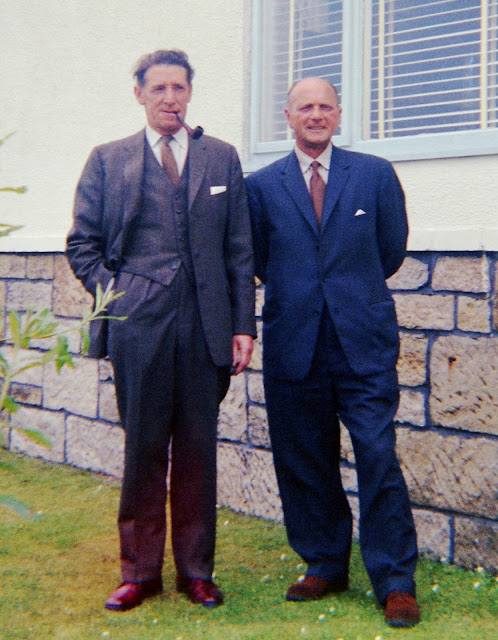
Leonard (on left) with a brother of his wife Mina outside Leonard's house "Culoran"

In 1970, Leonard started a trout farm at the Old Mill, Spynie, near Elgin. The following item was published in a national newspaper in 1978.
In 1984, Leonard had “Carousel”, a book of poems, illustrated by his brother Dennis, published.
The poems are mostly humourous. An example of a short one from the book is:

My neighbour’s grass is always green,
With not a daisy to be seen,
No clover patch, no chicken weed,
No dandelion, gone to seed.
It’s neat and trim and nicely mown,
With no bare patches to be sown,
In fact, it’s what a lawn should be
For sitting on and taking tea.
My garden lawn, I must confess,
Is not like that, it’s just a mess.

Leonard died on 21 August 1991 in Elgin aged 79. The following item was published in the Northern Scot and Moray & Nairn Express dated 23 Aug 1991.

Leonard's wife Mina died in 2002. They are buried together in Elgin Cemetery.
Leonard's grave

Wednesday, 20 January 2016

Frank Ivall (1901-86), Professional Singer

Frank Ivall was born on 4 November 1901 in Hackney. I don’t know the names of his parents. He was adopted by William Frank Ivall, a descendant of Charles Ivall (1779-1832). Adoptions at this time were either arranged by adoption societies or privately between individuals, a formal system was not introduced until 1927. An article about the life of William Frank Ivall is on this blog.

School records show that Frank was admitted to Eleanor Road School, Hackney on 28 January 1907, aged 5. His address was 342 Mace Street, which is in area of East London called Globe Town. He left the primary school on 22 August 1910 (aged 8) and transferred to the boys’ school on the same site.

The 1911 census lists William Frank Ivall (aged 39, a postman), his wife Sarah Jane (42) and Frank (9, their adopted son) living at 64 Navarino Rd, Dalston, Hackney. 

The family were living at the same address in the 1921 census, and William was still a postman. Frank, aged 19, was an instrument maker working for the Patent Lighting Company, Narrow St, Limehouse.

In 1924, Frank married Dora Gardner Crocker in Hackney. They were both aged 22.

Frank became a professional singer. He appeared in a musical comedy revue called “Stunts of 1924” which toured the UK. The Gloucestershire Echo, 30 December 1924 had the following item under the heading “Cheltenham Amusements”.

Coliseum Theatre

“Stunts of 1924” presented by Mr George Perry’s company at the Coliseum this week, provides one of the brightest and most enjoyable entertainments that we have the pleasure of seeing for quite a long time. It is a comparatively new show, and one that is certain to have a successful run. Much cleverness is shown in its construction. While it embodies the revue element, it also contains much that is original and novel, combined with scenes that approach very closely to the spirit of pantomime, and it is these features that give the performance its chief distinction, and lifts it both in tone and colour above the average revue level. An astonishing amount of entertainment is crowded into the performance. There are about fourteen scenes in all, and many of them are picturesquely mounted and dressed. Grand opera sung to rag-time, pretty vocal scenes symbolical of toyland, a charming butterfly scene by Miss Pauline Stone and the “Pearl Girls”, graceful dancing by little girls, and excellent singing and dancing by Miss van Biene, Miss Stone, Mr Louis du Cane, Mr Frank Ivall, and other members of the company, are some of the chief features of the show. Miss van Biene is also an accomplished cellist, and Mr Ivall reveals a phenomenal voice almost soprano-like in tone and flexibility. A breezy humour runs through the performance, and some sparkling comedy is seen in the several sketches in which Mr Perry, Mr Du Cane, Mr Glenroy, Mr Pat Allen and Mr Ivall collaborate.

The Aberdeen Journal dated 24 February 1925 refers to “Frank Ivall’s male soprano singing” saying that “Mr Ivall has a remarkable falsetto, which he uses to excellent purpose.”


The Era (a British weekly newspaper noted for its theatrical content) dated 23 May 1925 contained the item below.
The Era dated 18 May 1927 says Frank Ivall’s fine voice is heard to advantage in “Perhaps You’ll Think Of Me” and “Forgive Me” which he is featuring at The Palace, Blackpool this week with enormous success.

Electoral Registers for 1924 and 1927 show Frank Ivall living at 64 Navarino Road, Hackney with his parents William and Sarah Ivall. In 1928 the voting age for women was reduced from 30 to 21. The 1929 and 1934 registers show Frank’s wife Dora also living at this address. Frank Ivall is listed in the telephone directory at 64 Navarino Road between 1928 and 1934. Not many people had telephones at this time, so this seems to indicate that Frank was comfortably off.

Electoral registers show that Frank and Dora moved to 124 Graham Rd, Hackney (which is near Navarino Road) in 1935 and were still living there in 1963. Records indicate that they had no children.

The National Register prepared in September 1939 lists Frank, a vaudeville artist, and Dora at 124 Graham Road. He is a shown as a member of the Police War Reserve, which was introduced in 1939. War Reserve Constables (WRCs) were volunteers, who were part of the British Police Force and were given the full powers of a police officer. Duties of a WRC included the usual activities of a Constable, as well as enforcing blackouts, combating black market activity, assisting in evacuations and air raids, and capturing deserting soldiers. Uniform and equipment was the same as a regular Constable, with the exception of uniform epaulettes which were detailed WRC. Despite British police traditionally being unarmed, during the war officers were armed with rifles for protection from enemy action, enemy sabotage and to assist with the armed forces.

Frank’s mother Sarah died in 1943 and his father William in 1953. Perhaps surprisingly, the administration of his father’s estate was not performed by Frank but by his father's housekeeper, Annabelle Beatrice Cohen, who was the main beneficiary of his (incomplete) will. Some china and an oil painting were left to Frank.

Frank died in May 1986 aged 84 in the Epping Forest registration district. His wife Dora died 5 years later aged 89. Probate was not issued on either of their estates.

Tuesday, 1 December 2015

Mulberry and its Ivall connection

Mulberry is an upmarket fashion company known internationally for its leather goods, especially women’s handbags. The company was founded in 1971 by Roger Saul with the assistance of his mother Joan Saul nee Legg. Joan is a great granddaughter of Kate Bainbrigge Legg nee Ivall (1836-1917). Kate was a daughter of David Ivall (1795-1850), a highly successful coachmaker.

Roger Saul was ousted from Mulberry in 2003 following a boardroom coup in 2002. The Daily Mail published an article about Roger, based on an interview with him in 2011. http://www.dailymail.co.uk/news/article-2018144/The-man-lost-Mulberry--billion-pound-fortune-says-hes-NOT-bitter-amazing-success.html. 
It contains pictures of Roger plus information about his business life.

The BBC programme Countryfile broadcast on October 23rd 2016 contained an item about Roger's project to grow a commercial crop of walnuts on his farm in Somerset. Radio Times published an article about this, which is shown below (click on it to read the missing RHS text).
From Radio Times 22 - 28 October 2016

Saturday, 21 November 2015

Ken Ivall : Second degree murderer

A report dated June 30th 2013 in the Kenora Daily Miner and News http://www.kenoradailyminerandnews.com/2013/06/28/second-degree-murderer-sentenced-to-serve-minimum-16-years-in-prison begins

" Convicted of second degree murder, Ken Ivall, 43, will serve a minimum of 16 years in jail for causing the death of Kenora resident Ed Wilson more than four years ago."

The report contains information on the crime and a picture of Ken.

Kenora is a small city (population about 15,000) situated  in Northwestern Ontario, Canada, about 200 km east of Winnipeg.

I believe that Ken is descended from Alexander "Sandy" Ival (1831-1911, who emigrated to Canada from Scotland in 1837) via his third son Alexander (1855-1922).

As far as I know, the Canadian Ivalls are not related to the British Ivalls.

Monday, 16 November 2015

Ivalls in the 1939 Register

Information from a register of people living in Britain on 29 September 1939 has recently been made publicly available on the website Findmypast.

Germany invaded Poland on 1 September 1939. Britain and France declared war on Germany two days later. The British government needed information on its population to issue identity cards, plan mass evacuations, establish rationing, organise conscription and co-ordinate other wartime provisions. They employed 65,000 enumerators to visit every house in England and Wales and list 41 million people by household. Each person’s record contains their name, full date of birth, address, marital status and occupation.

When the NHS was founded in 1948, the register became the core of the NHS Central Register. Women’s surnames were updated when they changed as a result of marriage.

Under Data Protection legislation it is illegal to publish personal details relating to living individuals. Therefore the Information Commissioner has decided that the records of people born less than 100 years ago must be closed and so these entries are blacked out. Because the register was used by the NHS until the early 1990s many deaths up to this date were noted, allowing those records to be opened. The details of 28 million people can be seen at present.

There are 57 open records of people with the surname Ivall in 26 households on the 1939 register. It is quite expensive to view records from the 1939 register online from home, but it is free at The National Archives at Kew. I recently went there and looked up all of the open Ivall records. If you want me to send you details of any of them, please send me an email at PhilT42LQS@Yahoo.co.uk. 

I have added additional information from the register to biographies on the Ivall blog and also updated my family tree on RootsWeb. To view a list of Ivalls in it, go to  
(the names of living Ivalls are not shown on this list)

Update. As at 19 Jan 2017, there were 76 open records with the surname Ivall in the 1939 register. 

Saturday, 7 November 2015

Neil Ivall : "Paedophile Hunter"

A report on ITV news http://www.itv.com/news/anglia/2015-11-04/parents-turn-paedophile-hunters-after-their-own-daughter-is-targeted/ begins 

"Two self-styled 'paedophile hunters' from Bedfordshire who've already played a part in sending two men to jail say that they will continue to try and protect children. Neil and Katie Ivall from Dunstable started doing stings on potential paedophiles after their daughter was targeted online."


The report contains video of an interview with Neil and Katie.


Another article about Neil and Katie Ivall was published on the Mail Online on January 4th 2016
http://www.dailymail.co.uk/news/article-3383436/Paedophile-hunting-couple-capture-moment-caught-pervert-arriving-supermarket-meet-14-year-old-girl-luring-fake-Facebook-profile.html

I believe that Neil is in the branch of the Ivall family descended from Thomas Ivall (1837-1908), a baker who lived in Chalvey, which is now a suburb of Slough.

Sunday, 4 October 2015

Wartime Scrapbooks of Dennis Endean Ivall (1921-2006)

Dennis Endean Ivall was my second cousin, once removed. We are both descended from David Ivall (1816-67), a journeyman coachmaker. I never met Dennis, but we spoke by phone and he generously sent me a copy of the excellent research he had done on Ivall family history.

Dennis fought in World War Two. In about 2000, he prepared two scrapbook albums containing pen and ink and pencil sketches, Army Service papers, photographs, maps, newspaper cuttings, and other items all annotated and including commentary about his Army career relating to his service in the Home Guard and the Royal Army Ordnance Corps in India, Burma, Ceylon and Cocos Islands, with explanatory notes and pictures from various sources about the military units he encountered. These albums are now held in the archive collection of the Imperial War Museum in London. I recently visited the museum to see them.

When the war started, Dennis was living with his parents William Charles and Florence Bessie Ivall at 54 Beeches Avenue, Carshalton and working as an accounts clerk at the headquarters of ICI (Imperial Chemical Industries) in Westminster. The government requisitioned this building and so Dennis was moved to the ICI Alkali Plant in Winnington, Cheshire (1940). Here he joined the Local Defence Volunteers, which later became the Home Guard.

Dennis enlisted into the Army in February 1941, the scrapbook contains his Attestation Form and Soldier’s Service and Pay Book. He joined the RAOC (Royal Army Ordnance Corps), which had responsibility for weapons, armoured vehicles, other military equipment, ammunition and clothing. Dennis was sent for training at No 2 Training Battalion RAOC at Earl Shilton and Chilwell, Leicestershire. He was posted to India and travelled aboard HMT Cameronia to Durban in South Africa, transferring there to SS Aronda, which arrived in Bombay in September 1941. India was a base for the Middle East campaign at this time (it was before Japan entered the war). Dennis and 100 plus other RAOC Privates were attached to the Indian Army Ordnance Corps (IAOC) at Ferozepur, Punjab. They were all promoted to Sergeant, this being the lowest rank for any British soldier attached to the Indian Army.

Japan entered the war on the side of Germany in December 1941. Dennis was posted to Rangoon Arsenal, Burma. Japan invaded Burma and the Allied troops under command of Lieutenant General William Slim were forced to retreat in March 1942, destroying what would be useful to the enemy. Dennis says that oil refineries, port installations, workshops, vehicles and stores in Rangoon were demolished. The scrapbooks contain a transcription of a letter (dated June 1942) he sent home to his family in Carshalton giving details of the retreat through the Chindwin Valley and hills, arriving in Imphal. He walked 300 miles in 15 days.

In September 1943, Dennis was posted to the Ceylon Command Ordnance Depot. He was promoted to Warrant Officer and in November 1944 was moved with an Ordnance detachment to the Cocos Islands, which are about halfway between Ceylon and Australia. An air strip was built, which became operational in May 1945 as an air base to attack Japanese vessels, installations and bases on Java and Sumatra. RAF planes of No 99 Squadron (Liberator bombers) and No 136 Squadron (Spitfires) operated from there.

The war in the Far East ended on 15 August 1945 when Japan surrendered. After this, Dennis returned to the UK by ship arriving at Liverpool. He was eventually demobilised in August 1946. His war service resulted in Dennis being awarded the following campaign medals: 1939-45 Star, Burma Star, Defence Medal and War Medal.


Throughout the scrapbooks are sketches and paintings of people and places Dennis encountered, particularly of the different uniforms, clothing, races and tribes and soldiers he had seen. There are scenes from the retreat to Burma, aircraft, accommodation and entertainment, also photographs of native scenes, buildings, fellow soldiers, a group photograph of the staff of the RAOC on the Cocos Islands and a portrait photograph of Dennis.