Showing posts with label Children of Owen Ivall (b1846). Show all posts

Saturday, 10 January 2015

Robert Thomas Owen Ivall (1876-1953), fireman

Robert was a grandson of Robert Thomas Ivall (1812-65), the brother of my ancestor David Ivall (1816-67).  I have recently found paperwork (held by the London Metropolitan Archives) relating to Robert’s apprenticeship on the training ship Arethusa. It contains information about his early life, which I have added to this profile.

Robert was born on 6 September 1876 in Chalvey, a village which is now a suburb of Slough, Berkshire, and was baptised there on 15 October 1876. He was the fifth of six children born to Owen (b1846) and Emily Maria Ivall nee Moss (1845-83). They had 3 boys and 3 girls, although two of these children died before they reached adulthood.

The 1881 census shows Owen Ivall aged 35, a whitesmith (someone who makes or finishes items made of tin) living at 2 Sussex Place, Chalvey with his wife Emily Maria (34) and children Maria Emily(12), Eliza Ada (8) and Robert Thomas (4). There were several relations of Robert living in Chalvey at this time. Owen’s sister Marian was living at 6 Sussex Place with her husband Thomas Soen and their 5 children. Owen’s brother Thomas, his wife Lucy and their 6 children lived at 1 Jordan Place.

Robert’s mother died in 1883 when he was aged 6. His father married Sarah Smith nee Plumridge in 1885. Owen was arrested for public drunkness in 1886 and had frequent quarrels with his wife. They had separated by 1887.

Robert attended Chalvey National School for 5 years and Slough British School for 2 years, leaving in 1888 aged 12. He then did a series of menial jobs, cleaning knives and boots for 3 months, then working at a grocer’s for 4 months, a laundry for 12 months and a greengrocer’s for 3 months. I can’t find Robert or his family in the April 1891 census – they weren’t living at 2 Sussex Place then. Robert’s father deserted his children in June 1891, when Robert was aged 14. He tried to join the Royal Navy but was rejected for being just too short. By October 1891 Robert had been out of work for 3 months. However, he was then given the opportunity of an apprenticeship on board the training ship Arethusa, to learn the duties of a sailor.

In 1866, Lord Shaftesbury, a philanthropist and campaigner for the rights of children, promoted the idea of a naval training ship for homeless boys in London. Shaftesbury persuaded the Admiralty to loan a redundant 50-gun frigate called the Chichester. The ship was moored on the Thames off Greenhithe in Kent. It was managed by a committee of the 'National Refuges for Homeless and Destitute Children'. In 1873, following a donation of £5,000 from Lady Burdett-Coutts, a second ship was established. For this role, the Navy contributed the Arethusa, a wooden frigate which could accommodate staff and 250 boys. The Arethusa, built in 1849 had seen action in Crimea and was the last British ship to go into battle under sail. She took up position at Greenhithe and was officially opened on 3rd August, 1874. The Chichester was disposed of in 1889.

Training Ship Arethusa (in 1900)

Training for the boys included how use a compass and lead (to measure the depth of water), knotting and splicing rope, sail-making, knowledge of all running gear and parts of ship, reefing and furling sails, rowing and steering, swimming, cooking, carpentry and tailoring. Discipline was firm, punishments included birching. Arethusa boys were known on board only by their number, not by their name.

When Robert joined the Arethusa on 10 October 1891, he was aged 15, 4 foot 11¾  inches tall, his weight was 94 lbs and waist 30½  inches. He seems to have done well during his time on board – he was awarded two good conduct badges, a swimming prize, the Fleming Prize and the Rawlings Jersey. He was confirmed by the Bishop of Southwark at Greenhithe Church in December 1891. When Robert left the Arethusa on 30 September 1892, he was aged 16, 5 foot 1 inch tall, his weight was 112 lbs and waist 32 inches. He then obtained a job as a merchant seaman on “The Canada of Windsor” starting in October 1892. He worked on this ship for four periods between 1892 and 1895, each time being given a “very good” rating on discharge.

Robert joined the London Fire Brigade on 2 April 1898 aged 21. I have a copy of his service record. He was based at New Cross until 1 August 1900 when he transferred to Blackheath, where he stayed until 3 October 1901.

On June 22nd 1901, Robert married Florence Sarah Durnford at St John The Evangelist, Blackheath. They were both aged 24 and went on to have three children namely Robert Daniel (1902-92), Florence Sarah (1903-89) and Daniel Durnford (1905-2000). Both the sons later followed their father into the London Fire Brigade.

Marriage register entry for Robert

Parish records for the baptism of Robert Daniel Ivall in 1902 at St Thomas’s, Charlton, give the family’s address as 12 Springfield Park Crescent, Catford. When Florence Sarah Ivall was baptised in 1904, the address was Fire Station, Lordship Lane, Dulwich.

Robert had spells at Rushey Green (1901-3), Dulwich (1903-7), Eltham (1907-8), Greenwich (1908-9), Charlton (1909-10) and Perry Vale (1910-14) fire stations. The 1911 census shows Robert (aged 35, a fireman) his wife Florence (35) and children Robert (8), Florence (7) and Daniel (5) living at 199 Perry Vale, Forest Hill in SE London.

Robert was appointed a drill instructor in 1914 and spent the rest of his service as a Training Officer at the London Fire Brigade Head Quarters (in Southwark Bridge Road). In 1916 Robert was cautioned for accepting refreshments from strangers at a fire. In February 1918 he was personally thanked by the Chief Officer for services rendered. Having completed 20 years satisfactory service he was allowed to occupy married quarters in the Brigade rent free as from April 1918.

The 1921 census shows Robert (aged 44, a fireman working for the London County Council in Southwark) and Florence (45) living in 3 rooms at Southwark Fire Station with their children Robert (19, a messenger's mailing clerk), Florence (17) and Daniel (15, an office boy). 

Robert was promoted to the rank of probationary sub officer in 1922 and became a permanent sub officer in 1923. He retired from the London Fire Brigade in 1924 aged 47 after 26 years service and was awarded a pension of 62 shillings (equivalent to £93 at current values) a week. His record sheet shows “VG” for character and ability.

Robert then joined the Hampton Court Fire Brigade and lived in the palace grounds while he was stationed there. Electoral registers show him and his family at Hampton Court Palace from 1925 to 1936. He later developed heart trouble and retired to Bexhill, but didn’t like it there and moved to Abbey Wood in SE London. The 1939 national register and 1946 electoral register show him and his wife living at 4 Chancelot Road, Abbey Wood.

Robert died of cancer on 11 July 1953 aged 76 at 4 Chancelot Road and was buried in Plumstead Cemetery in grave 455, section O. 
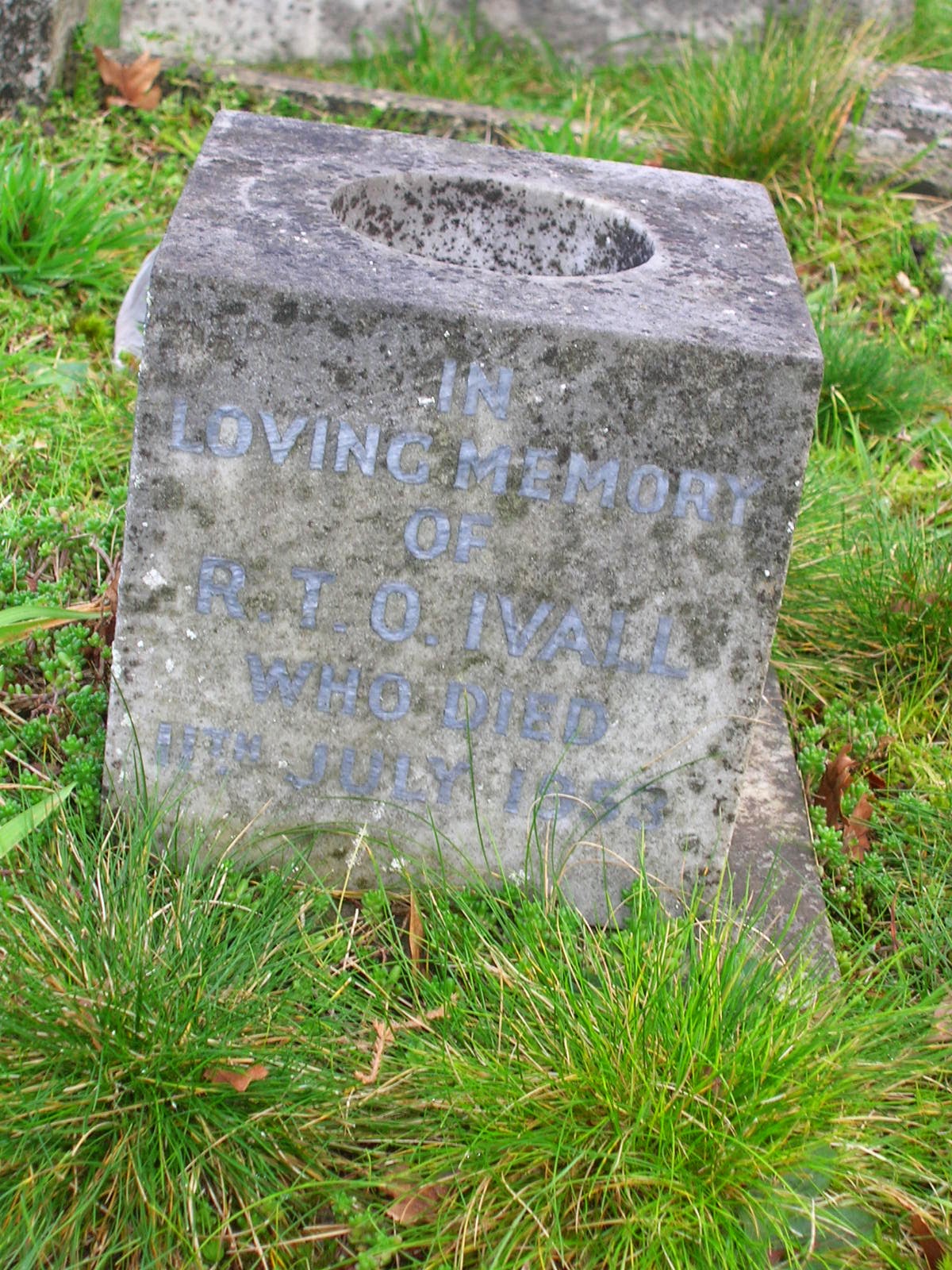

Memorial on Robert's grave

The probate index record reads
“Robert Thomas Owen Ivall of 4 Chancelot Rd, Abbey Wood died 11 Jul 1953. Probate to Robert Daniel Ivall, temporary civil servant. Estate £1,268.”


His wife Florence lived until 1974 when she died aged 98 and was buried in the same grave as Robert.

Thursday, 10 May 2012

Archibald Owen Ivall (1883-1917), the subject of an experiment

Archibald Owen Ivall was a grandson of Robert Thomas Ivall, the elder brother of David Ivall (1816-1867), my great great grandfather.

Archibald was born 23 February 1883 in Chalvey, a village near Slough in Buckinghamshire. He was the youngest of six children born to Owen Ivall (b1846) and Emily Maria Ivall nee Moss (1846-1883). His mother died 18 days after Archibald was born. Owen’s occupation was a whitesmith ie a polisher or finisher of metal goods. He married again in 1885 to Sarah Smith nee Plumridge (a widow). Both lived in Eton, which is near Chalvey. They argued frequently and separated in September 1887. I cannot find either Archibald or Owen in the April 1891 census, but have found what appears to be Sarah living alone. Owen Ivall deserted his children in June 1891.

On 4 September 1893, Archibald (aged 10) was admitted to the Royal Free Secondary Boys School, Windsor. The admissions register shows the name of his parent or guardian as Archie Ivall and his address as Dagmar Road. Archibald was withdrawn from the school on 16 February 1894, and the register says "Gone to Union". Presumably this means that he was transferred to the Union Workhouse.

In 1901, Archibald, aged 18, a domestic helper, was living in Lambeth at the house of his eldest sister Emily Maria (31), her husband Oliver Carter (40) and their children Joseph (3) Ethel (1) and Ivy (4 months).

Records show that Archibald was admitted to Lambeth Workhouse on September 13th 1904. He was discharged the following day to Lock Hospital, where venereal diseases were treated.

In 1910, The Daily Mirror initiated an “interesting agricultural experiment”. They picked men from the ranks of the unemployed in London and offered them work on a farm in Essex. An article on 29 March 1910, contained the following description of how they recruited Archibald.

The Daily Mirror eventually arrived at the Salvation Army shelter at Millbank, outside which a long line of men were waiting in file to purchase shelter for the night. From among these men one was chosen and offered work. His name is Archibald Ivall, born in Windsor and twenty-six years of age. The past ten years he has been in London. He has been an odd-job man most of his life. Since Christmas he has had no work at all, and before then he had earned a living as a porter. He expressed himself anxious for work and accepted immediately the terms offered to him.

A photograph of Archibald was printed in The Daily Mirror the next day.

The following item appeared in The Daily Mirror dated 7 October 1910 : 

FARMERS FROM EMBANKMENT

“Daily Mirror” Emigrants Sail Today to Farm in Australia

WORK GUARANTEED

Two strong, healthy, happy emigrants leave England for Australia this morning. They are Archibald Ivall and William Munson, The Daily Mirror farm labourers who, six months ago, were starving on the Embankment. It will be remembered that as a result of Mr Faulconbridge’s opinion that any healthy and sound man taken from any surroundings could be placed upon a farm and as a labourer be worth a living wage at once, The Daily Mirror arranged with Mr Faulconbridge to train these two men, who were picked at random from the Embankment.

STRIKING SUCCESS

How successful the experiment was our readers have already been told, and descriptive accounts of the men’s work and progress at the farm have been published from time to time in The Daily Mirror. They have learned to plough and sow, to feed and look after cattle, build a haystack and countless other duties of farm work. A brief diary of The Daily Mirror’s farming experiment is as follows :
February 10, 1910 – Mr Faulconbridge makes offer of farm work to unemployed men
March 25 – Munson starts work at Fen Farm, Ardleigh near Colchester followed by Ivall four days later
May 5 – Men making steady progress, Mr Faulconbridge enthusiastic
July 1910 – Men so improved that offers are made for them to go to Queensland, Australia. They decide to go after harvesting.
September 30 – Work concluded at Fen Farm. Complete success of experiment.

During this week, Ivall and Munson, assisted by The Daily Mirror, have been making arrangements for their passage.

FISH OUT OF WATER

Both men have been like “fish out of water” – to use their own expression – in London this week – they have missed the open, free life of the country. They sail from Liverpool this morning on board the steamship Dorset and will arrive at Brisbane, Queensland, the first week in December.
Work has been guaranteed them on arriving at Brisbane by the Queensland Government. They will work the land and both hope to have farms of their own very soon. Ivall is twenty-six and Munson twenty-one years of age. “I shall come back to England one day with my pockets full of money !” said the younger emigrant to The Daily Mirror yesterday.

An employee of the Gatton Agricultural College in Queensland had travelled to England to buy live cattle to ship back to Australia. He offered Ivall and Munson the opportunity of work in Australia, provided that they looked after the cattle during their journey there. Shipping records show that Archibald and William Munson left Liverpool on 7 October 1910 on board the Dorset, bound for Brisbane,

An item in The Daily Mirror of 28 October 1910 said that Mr Faulconbridge had sold his farm in Essex and also left England for Queensland. Shipping records show that Archibald Ivall arrived at Brisbane on the Dorset on 9 December 1910.

The Daily Mirror published this letter from Archibald on 1 May 1912

Agricultural College, Gatton, Queensland                                                           18 March 1912

Sir – Will you please accept my best thanks for training me through your Daily Mirror Scheme for the Unemployed for Farm Work and for sending me to Australia. I have been at Gatton College since I landed here and I have done very well. There is room for thousands more like myself, who are willing to work as I have for the last fifteen months. Mr Faulconbridge is on his way to England and when he returns I commence working on my own farm, a selection of 450 acres and I hope soon to be employing men. This will, I think, prove to you that there are many men as unfortunate as myself who might be trained on the land and better their position.
Again thanking you, yours obediently
                                                            (Signed) Archibald Ivall

There were items in The Daily Mirror on 17 and 18 May 1912 in which Percy Faulconbridge was interviewed. He talked enthusiastically of Archibald’s progress and prospects as a farmer in Australia. Percy said that he would like another 100 men to come out to Queensland to be trained by him and asked for applications. Assisted passages costing £6 would be available.

A story repeating information on The Daily Mirror “experiment” with Ivall and Munson appeared in the New York Times dated 2 June 1912. There don’t seem to be any more items in The Daily Mirror on Archibald Ivall.

The "selection" referred to by Archibald would have been an area of virgin land assigned to him by the Queensland government. It was necessary to clear the land of scrub and fence it, before it could be farmed.  It was common for farmers to "work off block" doing other jobs to generate income whilst this preparation stage was being done. Archibald is listed in the 1913 Australian Electoral Rolls as living in Laidley, Moreton, Queensland. Laidley is a small town about 50 miles west of Brisbane. His occupation is given as labourer in the first print and farmer in the second print for that year. When he joined the army in October 1915 he gave his occupation as a labourer on the railways.

The Australian National Archives website has documents recording Archibald’s service in World War 1. He enlisted on 9 October 1915 at Forest Hill, Queensland aged 32 years and 8 months. Forest Hill is a small rural township in the South of Queensland, a few miles north of Laidley. His height was 5 ft 4 inches and weight 9 stones 4 lbs. He was unmarried and gave his next of kin as his friend, Mr P Faulconbridge, Forest Hill, Queensland. This has been crossed out and Mr R T O Ivall (brother), The Fire Station, Southwark Bridge Road, London handwritten in, dated 3 January 1918 (Robert Thomas Owen Ivall, 1876-1953, was Archibald’s elder brother). Archibald embarked from Sydney on 20 February 1916 aboard the HMAT Ulysses, disembarking at Marseilles on 5 May 1916. He was a Sapper in the 1st Australian Tunnelling Company and took part in fighting near Ypres in Belgium. The Australian 1st Tunnelling Company Memorial at Hill 60 in Zwart-Leen, Ypres, remembers the men who fought above and below the ground to prevent the Germans from finding the galleries and mines. The Germans were holding this fiercely contested observation point in November 1916 when the Australian 1st Tunnelling Company took over the maintenance of the British mine beneath it. Today Hill 60 is an enclosed grassy area of craters, shell holes and mounds.

One of the most famous positions on the Western Front, Hill 60, had been formed in the 19th century from the soil taken from a deep railway cutting. It made a mound of 230 metres by 190 metres consisting of layers of clay, sand and quicksand. The hill's height of 60 metres gave it immense strategic importance in that flat country and both sides continually fought for it. The British tunnelled into the hill in 1915 and 1916 to plant mines which killed many Germans when they exploded. The 1st Australian Tunnelling Company under Major J. Douglas Henry took over the tunnels and mines on 9 November 1916. The Company's primary job was to keep intact two great mines being prepared for a major assault to break the enemy front. The galleries' drainage and ventilation was poor and to improve them the Australians sank a metal-lined shaft 130 metres from a main junction. Then they drove an additional gallery under the German line, about 400 metres away. The shaft was coded Sydney, the drive leading from it Melbourne, while defensive galleries were called Adelaide, Perth, Brisbane, Newcastle and Hobart. Protecting the mines from the Germans involved the diggers in ferocious underground fighting. The work was arduous and exhausting and six months' service in the tunnels of Hill 60 was regarded as the limit of strain any troops could stand. In one sector, the Australians reported that enemy miners were so close that their tools were shaking the earth in the Australian tunnel. They packed a ton of ammonal (an explosive) into the end of their tunnel and fired it on 16 December 1916. Recovering from this shock, the Germans continued their efforts to dig under the shallower Australian tunnels and blow them up. In March, April and May 1917, the Australians were tunnelling 5.5 metres a day in their efforts to prepare great mines for the impending attack on Messines Ridge. Every moment underground was dangerous.

Archibald died of wounds on 31st October 1917 in the 7th Australian Field Ambulance. I don’t know the circumstances of his death except that the 1st Australian Tunnelling Company were constructing dugouts near Ypres at this time (according to “The War Story of Oliver Holmes Woodward” a Captain in the Company). Perhaps Archibald was killed by a shell ? He was 34 and is buried in the Menin Road South Military Cemetery, Ypres. I have visited his grave.

Archibald’s service file contains several letters written by Mary Faulconbridge (wife of Percy Faulconbridge). She said that Archibald had told her that she was “the only mother he ever had”, that he was nominating her as his next of kin and would receive his military pay should he die. The Australian army’s reply was that nomination as next of kin on the enlistment papers gave her no rights to claim Archibald’s estate which was allocated by the Public Curator according to the law. The Public Curator told her that she could only receive his military pay if a will was found leaving her money. No will was found so Archibald’s money and effects were sent to his brother Robert Thomas Owen Ivall in England.

The War Memorial at St Mary’s Church, Church St, Slough lists 266 people, including A O Ivall (whose name is on one the stones around the base). His name is also on the Australian War Memorial in Canberra.